


Science
Our LEAF Award Journey
We are excited to be working towards the Bronze LEAF Demonstration School Award, as part of LEAF’s programme for schools.
LEAF – Linking Environment And Farming – is a charity that promotes more sustainable farming and helps children and young people develop a better understanding of food, farming and the environment. The LEAF Demonstration School framework provides schools with a practical way to bring these themes into everyday learning and wider school life.
Our journey towards the Bronze Award will build on our existing learning and give children opportunities to explore where their food comes from, how it is produced and the importance of looking after our environment. Through practical, hands-on experiences, children will be encouraged to ask questions, investigate, solve problems and make connections between their learning in the classroom and the world around them.
Working towards Bronze is about putting our LEAF pledge into action, trying new activities and building confidence in our approach to food, farming and sustainability.
Most importantly, this gives our children memorable, real-world learning experiences that can develop curiosity, teamwork, confidence and a greater understanding of sustainability and the natural environment. LEAF reports that this type of experiential learning can also support children's enjoyment, wellbeing and engagement with learning.
We are looking forward to sharing our progress and celebrating the children's learning as we work towards achieving our Bronze LEAF Demonstration School Award.
Find out more about LEAF at Home Page | LEAF (Linking Environment And Farming)
Science programmes of study: key stages 1 and 2
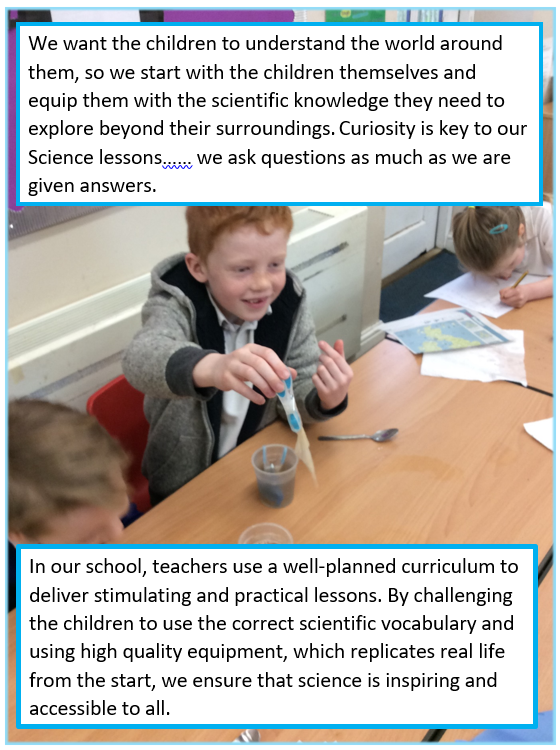
In our rapidly evolving world, science is a vital part of our curriculum intention. Science stimulates and excites pupils’ curiosity about phenomena and events in the world around them. It also satisfies their curiosity with knowledge; because science links direct practical experience with ideas, it can engage learners at many levels. Scientific method is about developing and evaluating explanations through experimental evidence and modelling. We strive to promote the love of learning science and for children to understand and be curious about the science within their everyday lives. We place value to the importance of an investigative approach through regular 'hands on' experiences wherever possible. It is our intention that by the end of each Key Stage, each child will understand a variety of scientific concepts and be able to confidently discuss them. We aim for all children to work scientifically during lessons and work collaboratively investigating different concepts and ideas.
To ensure children make the necessary progress and are challenged appropriately, teachers plan enjoyable, engaging and inspiring practical activities that mean the children are working hands-on; these lessons link science concepts to everyday life so the children can understand the world around them in a scientific way. Our lessons aim to develop a child's social skills by working in teams and encourage resilience, determination, perseverance, communication, collaboration, questioning and problem-solving. Pupils learn to question and discuss science-based issues that may affect their own lives, the direction of society and the future of the world.
National Curriculum Science
A high-quality science education provides the foundations for understanding the world through the specific disciplines of biology, chemistry and physics. Science has changed our lives and is vital to the world’s future prosperity, and all pupils should be taught essential aspects of the knowledge, methods, processes and uses of science. Through building up a body of key foundational knowledge and concepts, pupils should be encouraged to recognise the power of rational explanation and develop a sense of excitement and curiosity about natural phenomena.
Children are encouraged to understand how science can be used to explain what is occurring, predict how things will behave, and analyse causes.